Unlocking Efficiency in LLMs: TurboQuant's Revolution in KV-Cache Compression
Google's TurboQuant introduces advanced quantization and compression for LLMs and vector search, significantly reducing KV cache memory while maintaining accuracy, boosting RAG system efficiency.
Introduction
In the rapidly evolving landscape of large language models (LLMs), memory and computational efficiency remain critical bottlenecks. One of the most resource-intensive components is the key-value (KV) cache, which stores intermediate attention states during inference. To address this, Google has unveiled TurboQuant, a sophisticated algorithmic suite and library designed to apply cutting-edge quantization and compression techniques to both LLMs and vector search engines — a cornerstone of retrieval-augmented generation (RAG) systems.
The Challenge of KV Cache in LLMs
LLMs process sequences by attending to previous tokens, requiring the storage of key and value tensors for each layer and token. This KV cache grows linearly with sequence length and batch size, often dominating GPU memory usage. For long-context applications — such as document analysis, code generation, or conversational AI — the cache can exceed tens of gigabytes, making deployment on standard hardware impractical. Existing solutions, like pruning or low-rank approximations, either sacrifice accuracy or offer limited compression ratios.
How TurboQuant Addresses the Problem
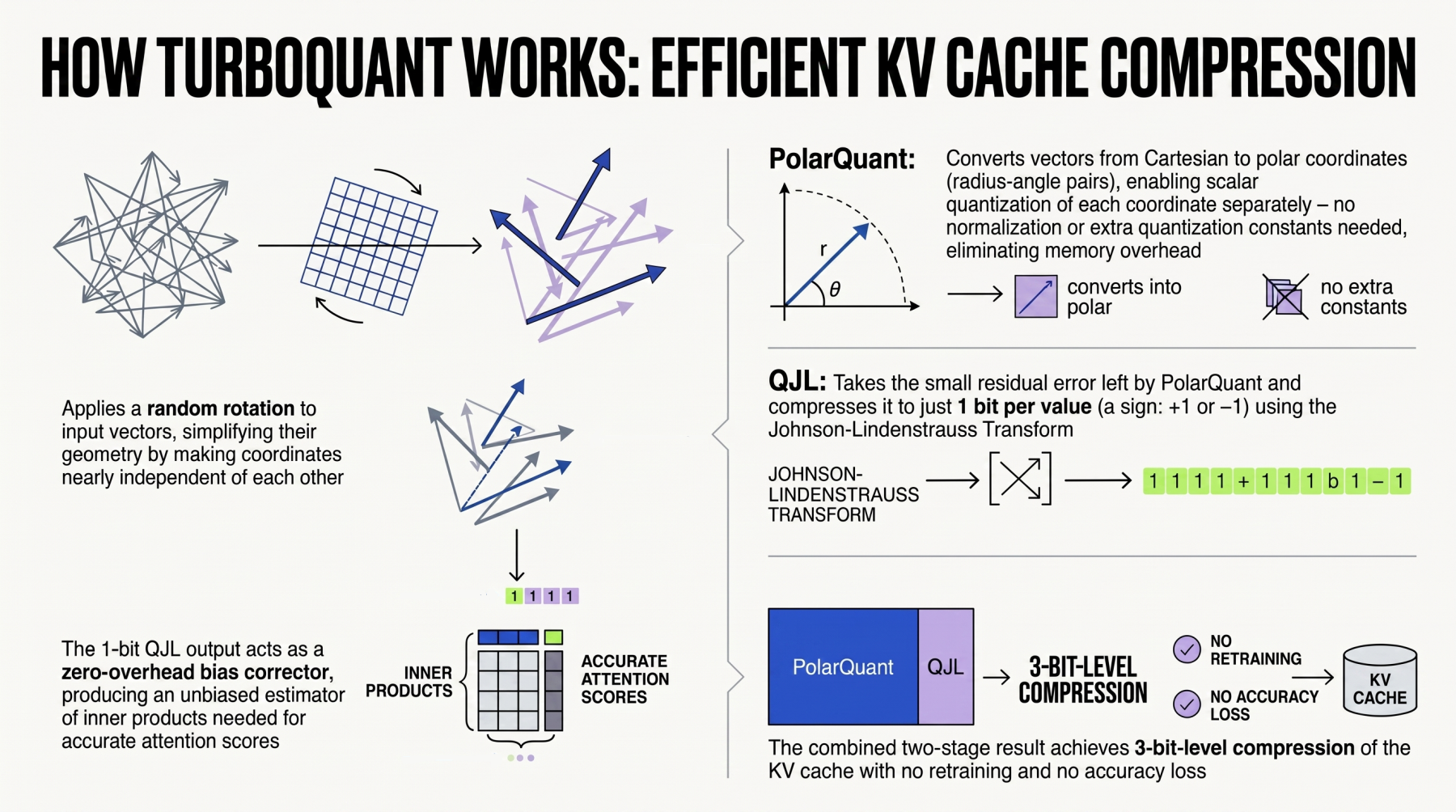
TurboQuant introduces a two-pronged approach: advanced quantization and dedicated compression algorithms.
Quantization Techniques
TurboQuant employs mixed-precision quantization that adapts bit-widths per tensor or even per token. By analyzing the distribution of KV cache values, it selects lower bit-widths (e.g., 4-bit or 2-bit) for less critical tokens while preserving higher precision for attention-critical ones. This dynamic allocation minimizes memory footprint without degrading generation quality. The library also supports calibration-aware quantization, where a small dataset is used to fine-tune scaling factors and offsets, achieving near-lossless compression.
Compression Algorithms
Beyond quantization, TurboQuant leverages Huffman coding and run-length encoding on the quantized residuals. By identifying patterns in the compressed representation, it can further reduce storage by 20–30% without additional computational overhead. The library also integrates with existing LLM frameworks (e.g., Transformers, vLLM) through a simple API, enabling drop-in replacement for standard KV cache management.
Impact on Vector Search and RAG Systems
Vector search engines, which index and retrieve dense embeddings, are similarly memory-hungry. TurboQuant extends its compression pipeline to these vectors, enabling higher index density and faster query times. In RAG systems, where LLMs pull relevant documents via vector search, this synergy reduces memory pressure on both the retriever and the generator. A typical RAG pipeline can see a 4× reduction in KV cache size, allowing larger context windows or more concurrent users on the same hardware.
Performance and Benchmarks
Internal benchmarks from Google show that TurboQuant achieves up to 8× compression on KV cache for models like Llama-2-7B and Mistral-7B, while maintaining perplexity within 0.1 of the floating-point baseline. For vector search, recall rates at high compression levels (e.g., 16×) remain above 95% on standard datasets like SIFT1M and GIST. These results highlight TurboQuant's ability to balance aggressive compression with practical accuracy requirements.
Integration and Future Directions
TurboQuant is released as an open-source library with Python bindings. Integration can be as simple as wrapping the model's KV cache with a TurboQuantCache object. Future versions aim to support on-the-fly quantization during training, allowing LLM fine-tuners to bake compression directly into model weights. Google also plans to extend support for multimodal models (vision-language) and edge devices.
Conclusion
TurboQuant represents a significant step forward in making LLMs and vector search more memory-efficient. By combining adaptive quantization with lossless compression, it addresses the KV cache bottleneck without compromising output quality. For developers building RAG systems or deploying long-context models, TurboQuant offers a practical, production-ready solution. As the library matures, it promises to unlock new capabilities in AI inference at scale.